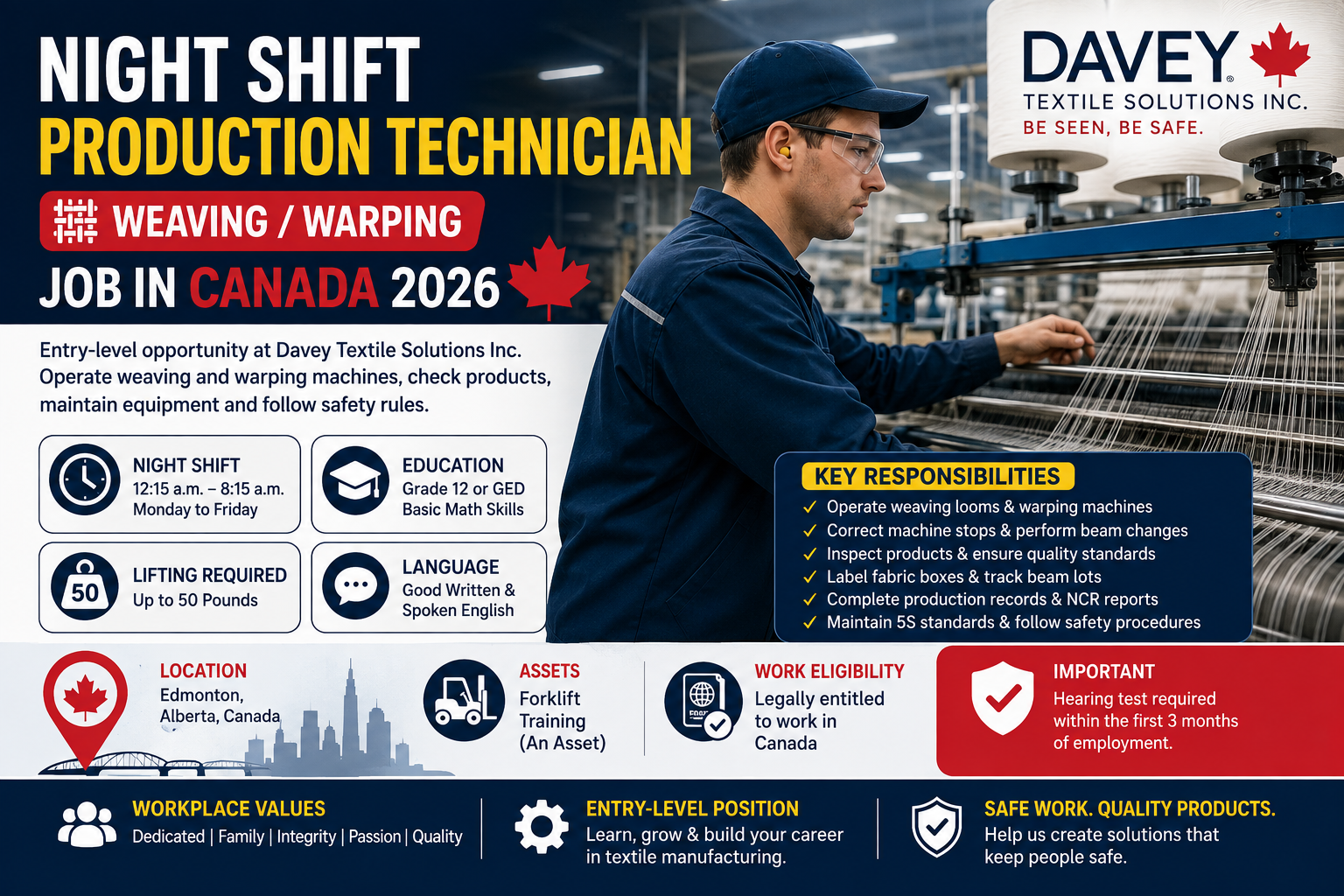
The Night Shift Production Technician job in Canada 2026 is an entry-level textile factory job. This position is the available at Davey Textile Solutions Inc. in Edmonton, Alberta, Canada.
The full job title is Night Shift Production Technician Weaving/Warping. The employee will operate weaving and warping machines. The worker will also check products, maintain machines, complete production records and follow safety rules.
The working days are Monday to Friday. The shift starts at 12:15 a.m. and ends at 8:15 a.m.
Applicants need Grade 12 education or a GED. They also need basic math skills and good spoken and written English. The worker must be able to lift up to 50 pounds.
Applicants must already have the legal right to work in Canada.
This article explains the company, job duties, working hours, education, physical requirements and main skills needed for this position.
Night Shift Production Technician Job Overview
The Night Shift Production Technician works in the weaving and warping area of the Davey Textile Solutions factory.
Here is the main information about this job:
Job title: Night Shift Production Technician – Weaving/Warping Employer: Davey Textile Solutions Inc. Location: Edmonton, Alberta, Canada Industry: Textile manufacturing Position level: Entry level Employment category: Hourly and the non exempt Working days: Monday to Friday Working hours: 12:15 a.m. to 8:15 a.m. Minimum education: Grade 12 or GED Mathematics requirement: Basic math skills Language requirement: Good written and spoken English Lifting requirement: Up to 50 pounds Forklift training: Considered an asset Work eligibility: Legally entitled to work in Canada
This is an hourly and non-exempt position. It may qualify for approved overtime under Alberta employment rules.
The job advertisement does not give information about the hourly salary, expected overtime or employee benefits.
About Davey Textile Solutions Inc.
Davey Textile Solutions Inc. has provided textile products and services in Canada since 1986.
The company makes textile products connected with safety, visibility, quality and service. Its mission is to help keep people safe through new textile solutions.
The company’s motto is “Be Seen, Be Safe.”
Davey Textile Solutions says that it works in sustainable textile innovation. The company uses technology and trained employees to develop and manufacture its products.
The company has more than 70 employees and operates in different locations.
Its main locations include:
A manufacturing facility in Edmonton A warehouse in Edmonton A distribution warehouse in Houston, Texas A sales office in Mexico
This Night Shift Production Technician position is based at the company’s manufacturing facility in Edmonton.
The company follows five main workplace values:
Dedicated Family Integrity Passion Quality
These values guide the company’s teamwork, employee behaviour, customer service and product quality.
Purpose of the Weaving and Warping Technician Position
The main purpose of this job is to help operate and maintain weaving looms and warping machines.
The technician helps make textile products according to customer requirements and company quality standards.
The employee operates machines, checks products, completes maintenance work and reports quality problems.
The job also includes cleaning the work area, completing production records, counting inventory, labelling fabric and keeping the workplace organised.
This is an entry-level position. It may help the employee learn more about textile production and industrial machines.
However, the employee must follow all operating instructions and safety rules from the first day of work.
Understanding the Weaving Process
Weaving is a process used to make fabric.
During weaving, two groups of yarn are joined together. One group of yarn runs lengthwise. The other group passes across it.
A weaving loom controls this process and produces the required fabric.
The technician helps keep the loom working correctly. The worker responds when the machine stops, checks the fabric and follows the approved weave instructions.
Problems with the yarn, machine settings or production process can affect the fabric.
For this reason, the technician must carefully watch both the machine and the material.
Understanding the Warping Process
Warping is a preparation process completed before weaving.
During this process, yarn is placed in the correct order and the wound onto a large beam. This is a work must follow the approved warping instructions.
Correct yarn placement is the important because the beam will later be used in the weaving process.
The technician operates and checks the warping machine. The worker corrects machine stops and changes beams when needed.
The employee must also record the correct beam and lot information.
Warping needs strong attention to detail. A small mistake during this process can create problems during weaving.
Setting Up Weaving and Warping Machines
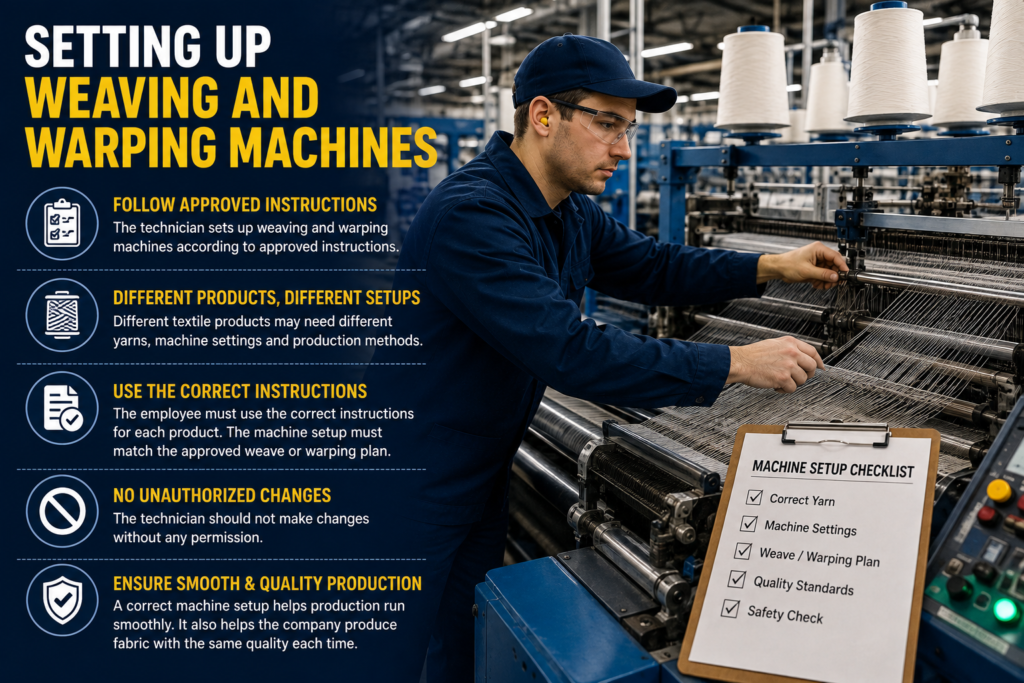
The technician sets up weaving and warping machines according to approved instructions.
Different textile products may need different yarns, machine settings and production methods.
The employee must use the correct instructions for each product. The machine setup must match the approved weave or warping plan.
The technician should not make changes without any permission.
A correct machine setup helps production run smoothly. It also helps the company produce fabric with the same quality each time.
Manufacturing Products to Customer Specifications
Davey Textile Solutions makes products according to customer requirements.
The production technician must follow the correct specifications for every production order.
These specifications may include the type of material, fabric design, product size, production lot and quality requirements.
The technician must use the correct instructions and materials for each order.
During production, the employee must look for any difference between the required product and the product being made.
If the material does not meet the required standard, the technician must follow the company’s quality procedures.
Operating Looms and Warpers
The technician operates weaving looms and warping machines.
These industrial machines may stop during production. When a machine stops, the technician must find and correct the problem by following the approved procedure.
Correcting machine stops safely and quickly can reduce production delays.
However, the employee must never put production speed before personal safety or product quality.
The technician must also watch how the machines are working. Repeated stops, unusual movement, oil leaks or changes in product quality may show that a machine has a problem.
The employee should report serious or repeated problems to the correct person.
Performing Beam Changes
A beam holds the yarn used during textile production.
A beam change may be needed when the yarn is finished or when the company starts a different production order.
The Night Shift Production Technician performs beam changes as part of the weaving and warping process.
The worker must follow the correct machine and material-handling procedures. Beam changes should always be completed safely.
The employee must also record the beam lot information. This information helps the company track the material used for each product.
Correct beam handling supports smooth production and accurate inventory records.
Inspecting Production Machinery
The technician regularly checks weaving looms and the warping machines.
The employee must look for machine problems and maintenance issues. The worker must also check the area around the machines.
This includes looking for oil or grease drips. Any oil or the grease should be cleaned according to company procedures.
Keeping machines and floors clean can be reduce safety risks. It also helps to keep the equipment in good condition.
The technician may complete assigned maintenance work. All maintenance must be follow company instructions and safety rules.
Product Quality Inspection
Checking product quality is an important part of this job.
The technician must inspect the material during production and look for any defects.
A defect may be found in the fabric, yarn arrangement or another part of the product.
If the technician finds a problem, the affected material must be checked carefully. Defective material must be separated from good products.
The technician must also inform the team lead about the problem.
Clear and quick reporting helps the production team understand the issue and take the correct action.
Defective products should never be mixed with products that meet customer requirements.
Non-Conformance Reporting
The technician must follow the company’s NCR process when needed.
NCR usually means non-conformance report. A non-conformance happens when a product, material or process does not meet the required standard.
The employee must complete the required paperwork correctly.
The report may include:
The type of problem The affected product The production lot The machine involved The action taken
Correct records help the company find, study and manage quality problems.
Labelling Fabric Boxes
The technician must put labels on boxes containing fabric.
Each label helps identify the product and connects it with the correct production information.
A wrong or missing label can cause problems with product tracking.
The employee must make sure that the correct label is placed on the correct box. All information should be clear and correct.
The technician may also prepare fabric samples when requested. These samples may be used for quality checks, company records or other business needs.
Beam Lot Tracking
Beam lot tracking is another duty of the technician.
Lot tracking helps the company identify which beam or batch was used to make a product.
This information is useful for production records, inventory control and quality investigations.
The technician must record the beam information correctly. It must be connected with the correct production order.
Accurate lot tracking helps the company follow materials through the manufacturing process.
Operating Sewing and Serging Machines
The technician may also operate sewing and serging machines.
A sewing machine joins pieces of fabric with thread. A serging machine is normally used to finish or secure the edges of fabric.
The employee must operate these the machines according to company instructions and safety rules.
The exact sewing and serging duties may depend on the product being made.
The job advertisement does not provide the machine models or the detailed information about the fabric-finishing work.
Following 5S Requirements
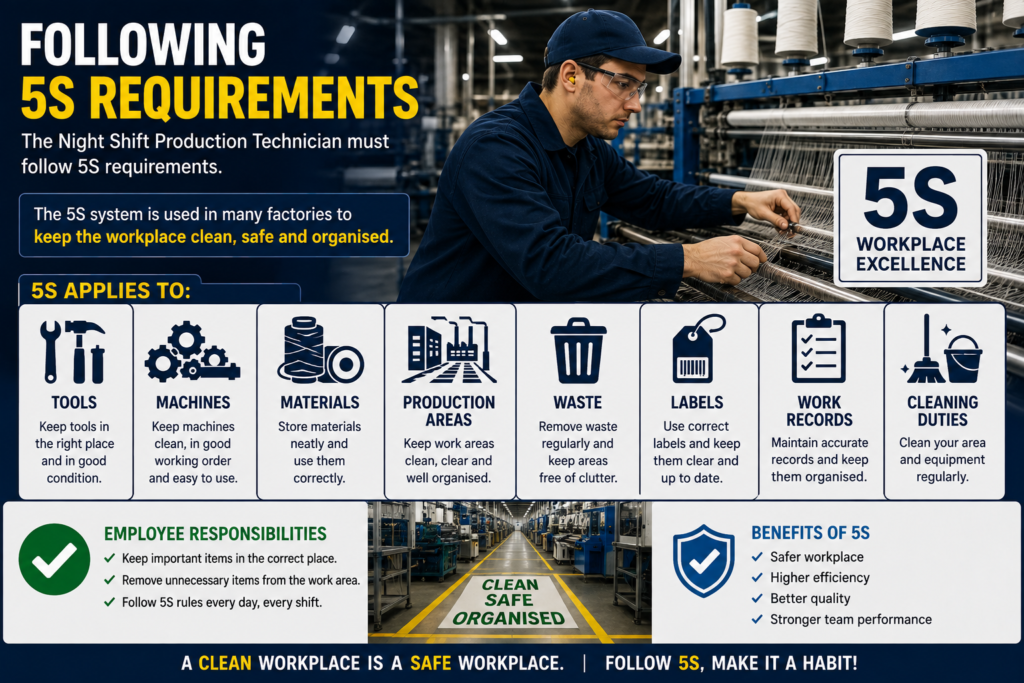
The Night Shift Production Technician must follow 5S requirements.
The 5S system is used in many factories to the keep the workplace clean, safe and organised.
In a textile factory, 5S may apply to:
Tools Machines Materials Production areas Waste Labels Work records Cleaning duties
The employee must keep important items in the correct place and remove unnecessary items from the work area.
Following 5S rules can make the workplace safer and help employees work more efficiently.
Cleaning and Shift Preparation
The technician must clean and a organise the work area before the next shift begins.
This may include removing waste, arranging materials and the leaving the machine area in the correct condition.
Good shift preparation helps the next team start work without delays.
It also helps employees receive clear production information and work in a clean environment.
The position includes weekly, monthly and yearly cleaning or maintenance duties. These tasks may be more detailed than normal daily cleaning.
The employee must complete them according to the company’s schedule.
Production Paperwork
The technician must complete daily production paperwork.
These records may include information about:
Production output Machine operation Product lots Quality problems Maintenance work Machine stops
All records must be complete and correct.
Production paperwork helps the company understand what the happened during each shift. It also keeps important information about the products made at the facility.
The employee needs enough written English to read instructions and complete these records correctly.
Reading and Responding to Emails
The employee must read and respond to workplace emails.
Emails may contain production updates, meeting notices, safety information, training details or other instructions.
The technician must understand written messages and send a clear reply when needed.
This is one reason why good written English is required for the position.
Inventory Counts and Preparation
The employee will help with inventory counting and preparation.
Inventory may include:
Fabric Yarn Beams Boxes Finished products Production materials
Correct inventory counts help the company understand how much material and how many products are available.
The technician must count items carefully and record the correct numbers.
Basic math skills are important for the inventory work and the production records.
Meetings and Training Sessions
The technician must attend company meetings and training sessions.
Meetings may cover production updates, safety rules, product quality or changes in the company procedures.
Training helps employees learn about machines, maintenance, safety and production work.
It can also help the employee improve their knowledge and practical skills.
Attending required meetings and training sessions is part of the job.
Safety Procedures and Policies
The employee must follow all company safety rules and procedures.
Textile factories contain industrial machines, moving parts and heavy production materials.
Employees should only operate equipment after receiving the correct training. They must use machines according to authorised procedures.
The technician must also keep the workplace clean and the take action when oil or grease is found.
Safety procedures may apply to:
Machine operation Machine stops Beam changes Equipment maintenance Lifting materials Cleaning Sewing and serging machines Handling defective products Moving around the workplace Using protective equipment
The job advertisement does not provide a complete list of required protective equipment or the all factory safety rules.
Hearing Test Requirement
The successful employee must complete a hearing test within the first three months of employment.
This is a special condition listed in the job description.
Textile machines can produce a high level of noise. Hearing checks may be part of the company’s workplace health and safety system.
The advertisement does not provide more information about the test or other hearing requirements.
Education Requirements
Applicants need Grade 12 education or a GED.
A college diploma, university degree or special textile qualification is not listed as a requirement.
This is an entry-level position, so the main education requirement is secondary school education.
Candidates also need basic math skills.
These skills may be used for counting inventory, recording production numbers, preparing labels and completing other daily tasks.
English Language Requirement
Applicants need good written and a spoken English.
Spoken English is important for talking with team members, reporting problems and understanding instructions.
Written English is needed for emails, production documents, NCR forms and the other workplace records.
The job information does not mention any formal English test, such as IELTS or the a required test score.
Physical Lifting Requirement
The employee must be able to lift items weighing up to 50 pounds.
The worker may need to handle materials, boxes and other production items.
Because this is a factory job, the employee may also spend time standing, walking around machines and completing physical tasks.
The advertisement does not list any other medical or physical conditions apart from the hearing test and lifting requirement.
Forklift Training
Forklift training is considered an asset.
This means it is a useful extra qualification, but it is not listed as a mandatory requirement.
A person with forklift training may already understand basic warehouse and material-handling procedures.
However, the job advertisement does not say that regular forklift operation is one of the main duties.
Core Competencies
The employer lists several important skills for this position.
Teamwork
The technician must work well with other employees.
The worker must clearly report machine, production and quality problems to the team lead or other team members.
Self-Development
The employee should be willing to improve their knowledge and workplace skills.
The technician may learn new production methods, machine procedures and maintenance tasks.
Personal Learning
The technician must learn how to use machines safely and correctly.
The employee also needs to understand quality standards, maintenance duties and company safety rules.
Organisation
The employee must manage production duties, cleaning, labels, records, fabric samples and inventory work.
Good organisation helps the technician complete these tasks correctly and on time.
Dependability
The company needs employees who come to work on time and complete their assigned duties.
Dependability is especially important because this position works during the night.
Attention to Detail
The technician must notice fabric defects, machine problems, incorrect labels and other production issues.
Strong attention to detail helps protect product quality and reduce mistakes.
Legal Right to Work in Canada
Applicants must be legally entitled to work in Canada.
The available job information does not mention:
Visa sponsorship LMIA support Work permit assistance Relocation support Free accommodation
Applicants should not assume that these services are available unless the employer confirms them through an official source.
Final Information
The Night Shift Production Technician Job in Canada 2026 is an entry-level textile manufacturing position at Davey Textile Solutions Inc. in Edmonton, Alberta.
The employee works Monday to Friday from 12:15 a.m. to 8:15 a.m.
The main duties include setting up and operating weaving and warping machines, correcting machine stops, changing beams and checking equipment.
The worker also checks product quality, labels fabric boxes, records beam lots, operates sewing and serging machines and completes production paperwork.
Applicants need Grade 12 education or a GED, basic math skills and good spoken and written English. They must be able to lift up to 50 pounds. Forklift training is considered an extra advantage.
The employee must follow 5S requirements, company safety rules, maintenance schedules and NCR procedures.
A hearing test must be completed within the first three months of employment.
The job advertisement does not provide the exact salary, employee benefits, application deadline or closing date.
Applicants must already be legally entitled to work in Canada. Visa sponsorship, LMIA support and work permit assistance are not mentioned in the available job information.