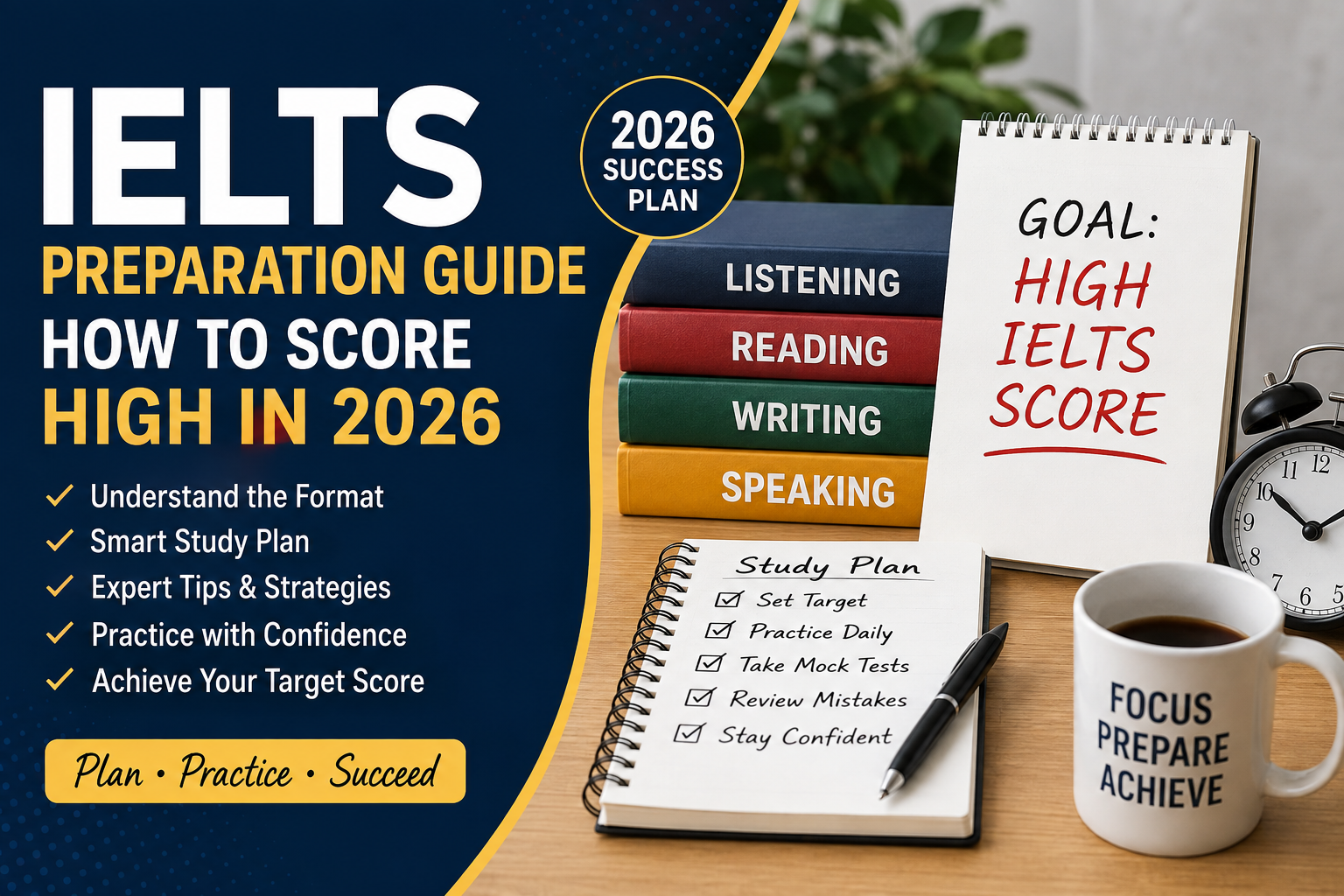
Introduction
Preparing for the IELTS exam may look difficult at first. Many students want a high band score to study abroad, move to the another country, or get a better job. Every year, many people take the IELTS test. Some get low scores because they try to memorize answers instead of a improving their English.
The good news is that getting a high IELTS score is possible. You do not need expensive classes or the secret tricks. You can only need the a good study plan, regular practice, official IELTS materials, and the a clear understanding of the exam.
This guide will help you prepare for the IELTS exam in 2026. You will learn about the test format, how to get the prepare for the each section, common mistakes, useful study tips and the simple ways to get a better score.
What is the IELTS Exam?
The International English Language Testing System (IELTS) is one of the most popular English tests in the world. The many universities, companies, immigration offices and the professional organizations accept IELTS scores.
There are two types of the IELTS tests:
IELTS Academic IELTS General Training
Choose the correct test before you can start preparing. Your choice depends on your study, work, or immigration goals.
Choose Your Target Band Score
Many students start studying without knowing the score they need. This is a common mistake.
Ask yourself:
Do you need Band 6? Band 7? Band 7.5? Band 8 or higher?
Knowing your target score helps you make the a better study plan and check your progress.
Computer-Based vs Paper-Based IELTS
In 2026, you can take IELTS on the a computer or on paper.
Computer-Delivered IELTS
Benefits include:
Faster results Easy editing in the Writing test On-screen timer Modern test experience Paper-Based IELTS
Some students like it be a because they can:
Write with a pen Highlight the reading passages Take the test in a traditional way
Choose the format that is a makes you feel more comfortable. Both tests use the same scoring system.
Understand the IELTS Test Format
It is very important to understand the exam before you start studying.
Listening
The Listening test has:
4 sections 40 questions Different English accents You hear each recording only once
Practice listening to different English accents. This will help you understand the recordings more easily.
Reading
The Reading test includes:
3 reading passages 40 questions Questions become more difficult as you continue
Try to spend about 20 minutes on each passage.
Learn these skills:
Skimming Scanning Finding keywords Understanding the meaning from the context
Good time management is very important in this section.
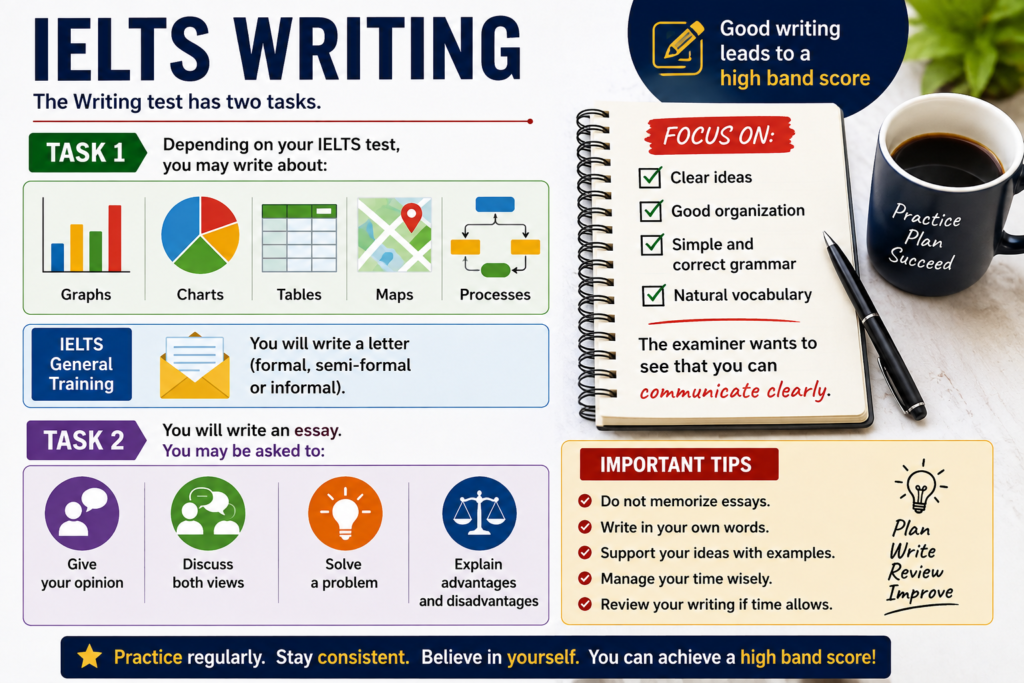
Writing
The Writing test has two tasks.
Task 1
Depending on your IELTS test, you may write about:
Graphs Charts Tables Maps Processes Letters
Task 2
You will write an essay. You may give your opinion or discuss a topic.
Do not memorize essays.
Instead, focus on:
Clear ideas Good organization Simple and correct grammar Natural vocabulary
The examiner wants to see that you can communicate clearly.
Speaking
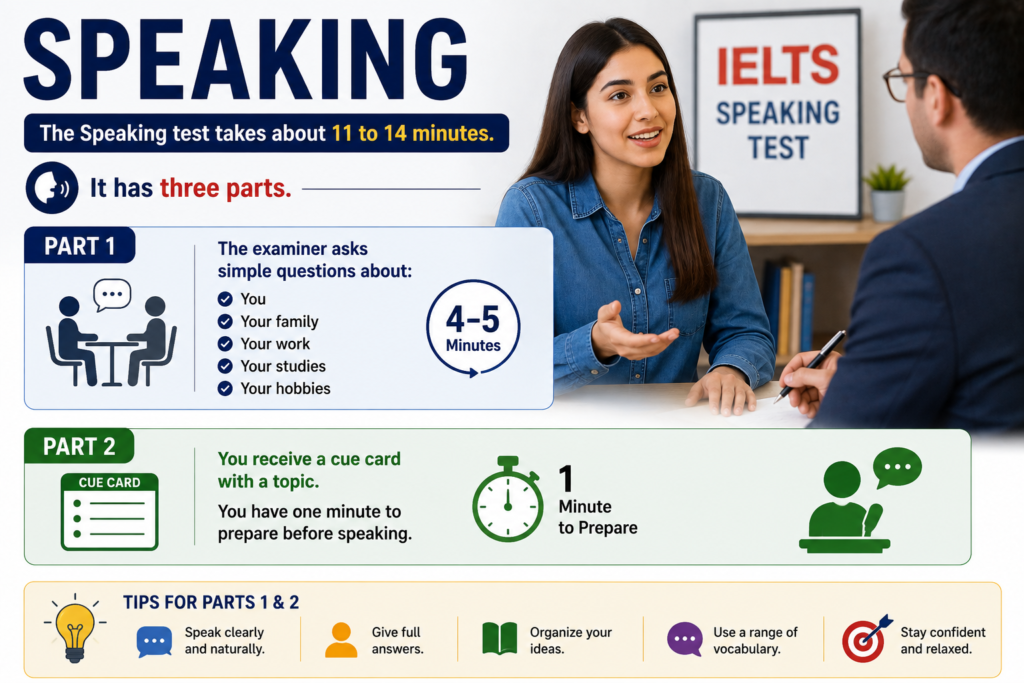
The Speaking test takes about 11 to 14 minutes.
It has three parts.
Part 1
The examiner asks simple questions about you, your family, your work, your studies, and your hobbies.
Part 2
You receive a cue card with a topic. You have one minute to the prepare before speaking.
Part 3
The examiner asks more questions related about Part 2. You discuss the topic in more detail.
Speak naturally and with confidence. Small grammar mistakes are okay if the examiner can understand you can clearly.
Build an Effective Study Plan
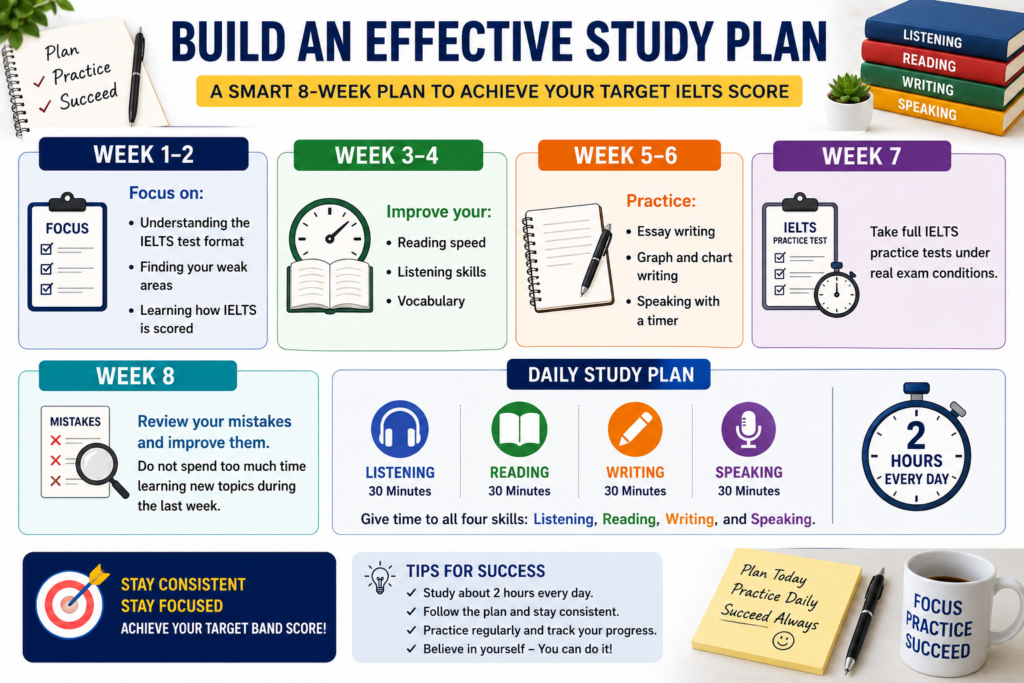
A good study plan can help you get a better IELTS score. Studying a little every day is better than studying for many hours in the one day.
An 8-week study plan is a good choice for the many students.
Week 1–2
Focus on:
Understanding the IELTS test format Finding your weak areas Learning how IELTS is scored
Week 3–4
Improve your:
Reading speed Listening skills Vocabulary
Week 5–6
Practice:
Essay writing Graph and chart writing Speaking with a timer
Week 7
Take full IELTS practice tests under real exam conditions.
Week 8
Review your mistakes and improve them. Do not spend too much time learning new topics during the last week.
Try to study about 2 hours every day. Give time to all four skills: Listening, Reading, Writing, and Speaking.
Practice Using Official IELTS Materials
Official IELTS materials are the best way to the prepare for the exam. They help you understand what the real test looks like.
Practice with official sample questions to learn:
Question types Time limits Difficulty level Instructions
Do not depend only on unofficial books or websites.
Improve Your Listening Score
Many students lose marks because they stop listening after missing one answer.
Instead, you should:
Keep listening carefully. Guess what answer may come next. Learn the correct spelling of common words. Practice taking short notes. Listen to different English accents.
Even 20–30 minutes of listening practice every day can improve your score.
Improve Your Reading Score
You do not need to understand every word in the reading passages.
Students with high scores usually:
Read smartly. Look for keywords. Find words with similar meanings (synonyms). Skip difficult questions and come back later.
Reading English articles, newspapers, and blogs every day also helps improve your vocabulary.
Improve Your Writing Score
Good writing is simple, clear, and well organized.
Focus on:
Answering the question correctly. Writing clear paragraphs. Giving examples to support your the ideas. Using natural vocabulary. Checking your grammar, spelling, and the punctuation.
Do not memorize introductions or conclusions. They often sound unnatural.
Improve Your Speaking Score
The best way to improve Speaking is to practice every day.
Try to:
Speak English every day. Record your voice. Answer IELTS Speaking questions. Think in English. Speak clearly and naturally.
Do not worry if you make small grammar mistakes. Speaking clearly is more important than speaking very fast.
Manage Your Time Effectively
Many students know the correct answers but cannot finish the test because they run out of time.
During your preparation:
Use a timer while practicing. Take full practice tests. Learn when to move to the next question. Do not spend too much time on one difficult question.
Good time management can a help you get a higher IELTS score.
Common IELTS Mistakes
Many students make the same mistakes in the IELTS exam. If you avoid these mistakes you can easily improve your score.
Do not:
Ignore these instructions. Memorize essays or answers. Spend too much time on one question. Practice only sometimes. Use very limited vocabulary. Try to use very difficult grammar all the time. Forget to review your mistakes.
Every mistake is a chance to learn. Always check your errors and try not to repeat them.
Vocabulary Development
A good vocabulary helps you in all four IELTS sections.
You can improve your vocabulary by:
Reading English books and the articles. Learning useful phrases instead of single words. Writing new words in the a notebook. Reviewing new words every week.
Do not use difficult words just to impress the examiner. Use words that you know well and can use correctly.
Grammar Matters
Good grammar is important for a both the Writing and Speaking tests.
Practice these grammar topics:
Different sentence types Verb tenses Subject and verb agreement Articles (a, an, the) Punctuation
Simple and correct grammar is better than the difficult grammar with mistakes.
Should You Memorize Templates?
Many students search for the IELTS essay templates.
Learning the essay structure is helpful, but memorizing full essays is not a good idea.
Examiners want to see your own English.
Instead, learn how to:
Organize your ideas. Make a simple writing plan. Write in your own style.
This will help you write better answers in the exam.
Use Full-Length Mock Tests
Mock tests are one of the best ways to a prepare for IELTS.
They help you:
Build confidence. Improve your speed. Find your weak areas. Feel less nervous on exam day.
Always take mock tests like the real IELTS exam. Use a timer and do not take the extra breaks.
One-Skill Retake
Some IELTS test centers offer a One-Skill Retake option.
If you do not get the score you need in one section, you may be able to take that section again instead of the repeating the whole test.
Before you make your plans, check if your IELTS test center offers this option.
Exam Day Tips
Before the exam:
Get a good night’s sleep. Reach the test center early. Bring your ID or the passport. Stay calm. Read all instructions carefully.
During the exam:
Do not panic if you do not know one answer. Move to the next question if needed. Watch your time. Check your answers if you have time at the end.
Stay relaxed and do your best.
Frequently Asked Questions
How long should I prepare for IELTS?
Most students need 6 to 8 weeks of regular study. The exact time depends on the your current English level and the band score you want.
Is computer-based IELTS easier?
No.The computer-based and paper-based IELTS tests use of the same scoring system.
Choose the one you feel more comfortable with.
Can I prepare without coaching?
Yes.Many students get the high IELTS scores by studying at home with official IELTS materials and taking regular mock tests.
Should I memorize essays?
No.Learning the essay structure is helpful, but the memorizing essays is not recommended. It can make your writing sound unnatural and may not answer the real exam question.
Final Thoughts
Getting a high IELTS score in 2026 is possible if they you prepare the right way.
Start by choosing your target band score. Learn the IELTS test format and follow a simple study plan. Practice every day with official IELTS materials, improve your time management, and work on all four skills.
Do not look for shortcuts. Keep practicing, learn from your mistakes, and stay confident.
Every day you study brings you one of step closer to your goal. With the regular practice and hard work, you can be get the IELTS score you need for the your studies, your career, or the the your immigration plans.