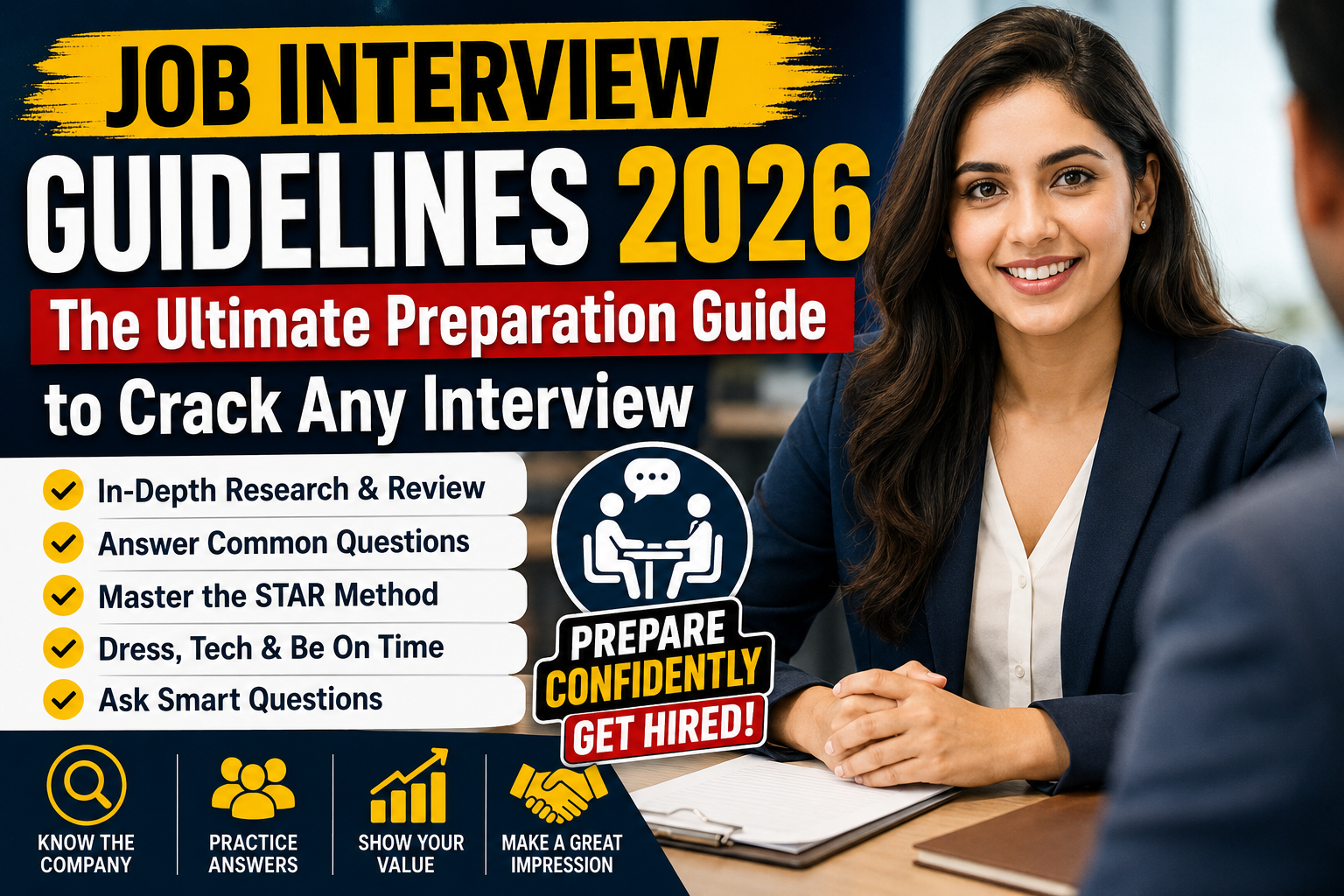
Let us talk about job interviews. They can feel very scary for a lot of people. When you want a job really badly, your hands might sweat. Your heart might beat fast. You might worry that you will say the wrong thing. But there is a secret to making that fear go away. The secret is very simple: good preparation. Getting a job today takes more than just a good resume. In 2026, the world is very fast. A lot of the smart people are looking for the same jobs as you. You need to know how to stand out from the crowd and show them you are the absolute best choice for the their team.
This guide will be the help you prepare step-by-step. We will talk about everything from reading the job post to what clothes you should wear. If you read this and follow the steps carefully, you will feel very confident. You will know exactly what to say when they ask you hard questions. You will get the job you want. Let us start this journey together and get you ready for your big day.
Phase 1 In Depth Research and Review
Do your homework long before the interview starts. Employers want people who really understand the job and the company. They do not want someone who is just looking for any job to make money. They want someone who cares.
1. Read the Job Post Carefully
Employers spend a lot of time writing job posts. They tell you exactly what they want in that post. Do not just skim the page and apply quickly. Read every single line. Read it two or three times if you have to. Find the main skills and tools they are asking for. Are they asking for someone who knows how to use certain computer programs? Are they asking for someone who is very good at talking to angry customers on the phone?
Figure out the big problem they need to solve. Maybe their sales are too low right now. Maybe their team is messy and needs a good manager. Once you know their main problem, you can show them you are the perfect person to fix it. Get a notebook and a pen. Write down notes on a piece of paper. Match their words in the job post with your own skills. This way, when you talk, you can use the exact words they used.
2. Study Your CV Inside Out
Your CV, or your resume, is the reason you got the interview in the first place. The employer liked what they read on that paper. Now, you have to prove to them that it is all true. Know everything on your resume very well. Sometimes people forget what they wrote because they made the resume a long time ago. Read it again before you go to the interview.
If you say on your paper that you boosted sales by 20%, be ready to explain exactly how you did it. What steps did you take? Did you work late nights? Did you call more people on the phone? Did you change the way the store looked? Show how your past hard work will help you in this new job. Also, never lie on your resume. If they ask a question and you do not know the answer to your own resume, they will know you lied. Be honest, be truthful, and be proud of your past work.
3. Learn About the Company
You cannot go to an interview knowing nothing about the company. That is a very bad idea and a quick way to get rejected. You have to learn about them. Check their website and their social media pages like Facebook, Twitter, and LinkedIn. Know what they sell. Do they sell cars? Do they sell software? Do they sell food? Know who they sell to.
Know what they believe in. Read their latest news on the internet. Did they win a big award recently? Did they open a brand new office in another city? If you talk about their recent news during the interview, the interviewer will be very happy and surprised. They will think, “Wow, this person really cares about us and did their homework.” You can also talk to people who work there if you know any. It shows you do more than just the basic work.
4. Look Up Your Interviewer
Do you know who is going to interview you? If you do not know, you can politely ask the company for their names in an email. Then, look up the person interviewing you on LinkedIn. Do not add them as a friend on your personal Facebook, because that is not professional. Keep it to work sites.
See if you went to the same school. See if you know the same people. Maybe you both like the same things in your work field. People like to hire people they connect with and feel comfortable around. If you see they have worked at the company for ten years, you know they really love the company and are very loyal. If they just started working there last month, they might want new ideas from you. Knowing about your interviewer makes them feel like a normal human being, not a scary judge who is trying to fail you.
Phase 2: Practice Common Interview Questions
Some questions are always asked in almost every single interview. Here is how to answer them simply and clearly so you sound very professional.
How to Answer: “Tell Me About Yourself”
This is usually the very first question they will ask you. It is meant to break the ice and start the talking. Keep your answer short. Do not tell your whole life story. They do not need to know where you were born, how many pets you have, or what your favorite food is. Keep it focused on your work life.
Talk about your past jobs first. Say, “I started working at this place and learned this very important skill.” Then, talk about what you are doing right now. Say, “Right now, I am managing a team of five people and doing this type of work daily.” Finally, tell them why you want this new job. Say, “I am here today because I want to grow my career and your company is the best place for me.” Practice this answer in the mirror at home. Keep it under two minutes so they do not get bored listening.
Answering: “Why This Job?”
You need to show you really care about what they do. Employers do not want someone who just wants money. They want someone who actually likes the work. Connect your own personal goals to the company’s goals.
Talk about specific things in the job post that sound exciting to you. Say things like, “I saw that this job requires a lot of writing and talking to clients. I love writing, and I have done it for three years. It is my favorite thing to do.” Make them believe that this is the only job you want in the whole world. Smile when you talk about the work. Your face should look happy. Enthusiasm is very important. If you look bored or tired, they will not want to hire you.
Addressing: Strengths and Weaknesses
This is a tricky part of the interview, but you can do it well if you prepare. Pick real strengths that fit the job perfectly. If the job is about talking to people all day, say your biggest strength is communication and making people feel heard. Give a small example to prove it.
For weaknesses, you must be honest but you must also show how you are fixing the problem. Never say things like “I work too hard” or “I am too much of a perfectionist.” Employers know that is fake and they do not like it. Say something real and human. For example, say, “I used to be very bad at public speaking. I would get very nervous in front of groups. But I joined a special class to get better, and now I practice every week. I feel much more confident now.” This shows you know your own flaws and you work very hard to fix them.
Phase 3: Mastering the STAR Method for Behavioral Stories
When the interviewer asks, “Tell me about a time when…”, they want to hear a real story from your past. They want proof that you can handle hard things at work. Use the STAR method to tell a very clear story. It keeps you from talking too much and getting lost in your own words.
S – Situation: Explain the problem you faced. Keep it very short. Where were you working? What was going on? For example, “Last year at my old job, we had a huge project due for a big client, but two people on my team got very sick and could not come to work.”
T – Task: Say what your specific job was in that situation. What did you have to do? Tell them clearly. “It was my job as the team leader to make sure the project was still finished on time even without those two people to help us.”
A – Action: Tell them the exact steps you took to fix the big problem. Say “I did this,” not “we did this.” Employers are hiring you today, not your old team. Say, “I organized an emergency meeting. I gave out new tasks to everyone. I personally stayed late at the office for three nights to finish the extra work myself.” Be very clear about your own hard work.
R – Result: Share how the story ended. Use numbers if you can to show your success, because business people love numbers. “Because of my hard work and late nights, we finished the project one day early. The client was very happy and gave us a five-star review.”
You should practice 4 or 5 different stories like this before you go to the interview. Write them down in your notebook. Practice telling them out loud to a friend or a family member so you do not stumble on your words.
Phase 4: Logistics and Presentation
Having really good answers does not matter at all if you look messy, smell bad, or if your internet keeps dropping out during the call.
What to Wear to a Job Interview 2026
Dress nicely. What you wear shows how much you respect the interview and the people talking to you. Do some research on what people wear at that specific company. If it is a formal bank or a law firm, wear a full suit and a tie. If it is a modern tech startup or a creative agency, wear a nice, clean button-down shirt and nice dress pants. It is always better to dress a little too nice than too casual.
Make sure your clothes are very clean and ironed well. Do not wear clothes with wrinkles. Polish your shoes so they shine. Brush your hair neatly. Make sure you brush your teeth. Do not wear too much heavy perfume or cologne because it can give people a headache. Keep your fingernails clean and trimmed. Looking neat and tidy tells the employer that you take care of small details in life, which means you will take care of details in your work. It gives a great first impression before you even open your mouth to speak.
Tech Check and Travel Planning
If you are going in person to the office, plan your drive carefully. Look at the map the night before. Know exactly where you will park your car or where the bus stops. Check the traffic in the morning. Get to the building 10 to 15 minutes early. Do not be late. Being late is the absolute worst thing you can do. It shows you do not respect their time and you are not responsible. But also, do not arrive a full hour early, because that makes the office staff feel rushed and uncomfortable.
If you are doing the interview on a video call on your computer, test your camera, microphone, and internet first. Call a friend on the computer to make sure they can hear you loud and clearly. Sit in a quiet room with the door closed. Tell your family to be quiet. Put a bright light in front of your face so the interviewer can see your eyes. Make sure the background behind you is clean and plain. Do not show a messy bed or dirty clothes in the background. Make sure your laptop computer is plugged into the wall so the battery does not die in the middle of your talking. Look directly at the camera hole, not at the screen, so it feels like you are making real eye contact with them.
Phase 5: Prepare Thoughtful Questions to Ask
An interview is a two-way street. At the very end of your time together, the interviewer will almost certainly ask you, “Do you have any questions for us?” When they ask this, never say no. Saying “no” makes you look bored and like you do not care about the job. You want to look very curious and excited. Ask smart questions like these:
What does a normal, day-to-day day look like in this job? (This helps you know if you will actually like the daily work you have to do).
What is the biggest problem the team is facing right now? (This shows you want to come in and help them fix their hard things right away).
How do you know if someone is doing a good job in the first 90 days? (This shows you care about being successful and meeting their business goals).
What is the team culture like here? (This helps you know if you will make friends and enjoy working with these people every single day).
You can write these questions down in a small notebook and bring it with you. It is completely okay to look down at your notebook to read the questions. It actually shows them that you prepared very well and took the time to write things down.
Conclusion: Ready for Success
Let us bring all of this together. Preparation is the golden key to removing all of your fear and anxiety. Job interviews do not have to be a scary nightmare if you do the hard work before you walk into the room. If you follow this detailed guide, you will transform from a nervous applicant into a strong, confident candidate.
You will not have to guess what to say or worry about making mistakes. You will read the job post over and over until you know it by heart. You will learn everything about the company and the interviewer. You will practice your STAR method stories in the mirror or with your family until they are perfect. You will dress nicely, have clean shoes, and make sure you are always on time. You will check your computer microphone and camera. Finally, you will ask wonderful, smart questions at the very end.